“Heck, How Do We Pay the Tax Bill?”
Running a small business can sometimes feel deceptively simple when you look at the bank balance. Money comes in, bills go out and, if there’s still a healthy-looking figure sitting in the account, everything must be going rather well.
Until, that is, the VAT return, corporation tax bill or self-assessment payment arrives.
Suddenly that comfortable bank balance doesn’t look quite so comfortable.
The problem is that money in the bank isn’t necessarily money you have available to spend. Some of it may already belong to HMRC, some may be needed for suppliers or payroll next month, and some may need to see you through a quieter period.
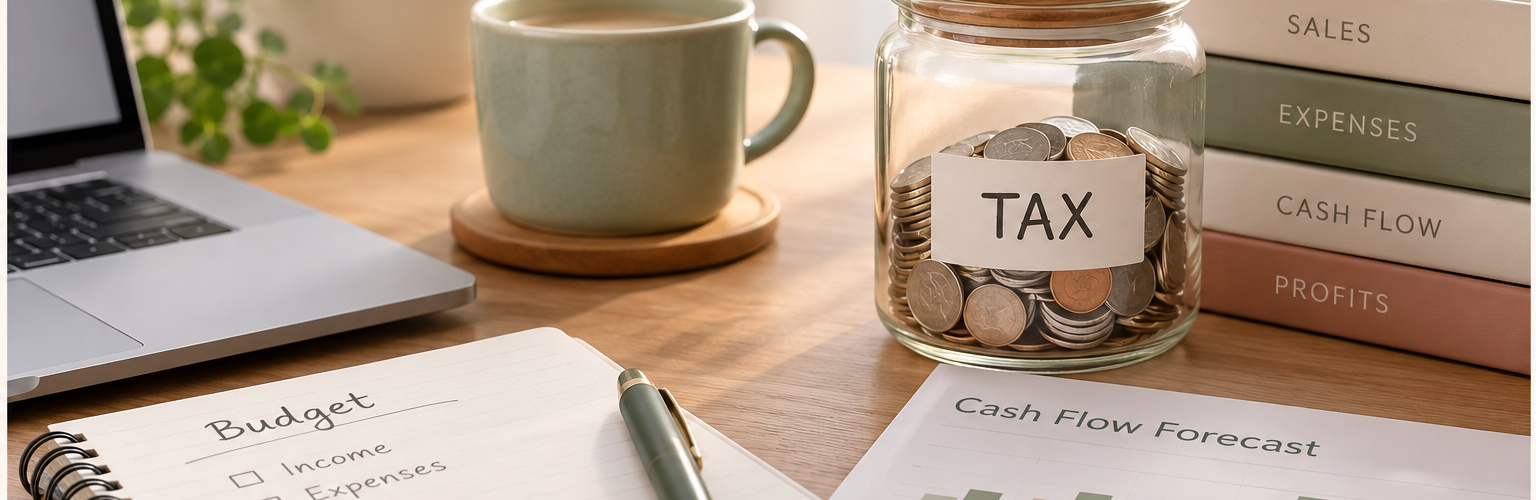
That’s why even very small businesses benefit from two fairly simple financial tools: a budget and a cash-flow forecast.
What’s the difference between a budget and a cash-flow forecast?
They sound rather similar, but they tell you different things.
A budget is your financial plan. It estimates what you expect the business to earn and what you expect to spend over a particular period.
A cash-flow forecast looks at when that money is actually expected to enter and leave your bank account.
And that timing matters.
You might raise £10,000 worth of invoices in March and have a very profitable month on paper. But if your customers don’t pay those invoices until May while your wages, rent, software subscriptions and suppliers all need paying in April, you can still find yourself short of cash.
A profitable business can have a cash-flow problem.
Why bother with a budget?
For many small-business owners, budgeting can feel like something bigger companies do in boardrooms with complicated spreadsheets.
It really doesn’t need to be.
A useful small-business budget can simply set out your expected income alongside your regular and anticipated costs.
Once you can see those figures together, you can start answering some much more useful questions.
Are you charging enough? How much do you need to sell each month to cover your costs? Can the business afford that new piece of equipment? Could you take on another member of staff? What happens if sales fall for two months? And are your costs quietly creeping upwards without you noticing?
Rather than looking backwards at what happened last year, a budget encourages you to look ahead and make decisions before there is a problem.
Then add a cash-flow forecast
This is where things become particularly useful.
Your cash-flow forecast takes what you know about your business and maps out approximately when money should come in and when it needs to go out.
It doesn’t need to predict the future perfectly. It won’t.
The point is to give you enough visibility to spot the bumps in the road before you reach them.
For example, you might discover that November and December look fantastic, but January is going to be decidedly uncomfortable. Or that a large annual insurance premium falls in the same month as a tax payment. Or that several major customers routinely take 30 or 60 days to pay.
Knowing that three or six months beforehand gives you options.
Discovering it three days beforehand gives you considerably fewer.
Don’t forget the taxman
One of the easiest traps for a small business is treating tax money as though it belongs to the business.
It doesn’t.
If you’re VAT registered, some of the money customers pay you may be VAT you’ll later need to hand over to HMRC (after accounting for eligible VAT on purchases). Depending on how your business is structured, you may also need to plan for corporation tax, PAYE or self-assessment payments.
A simple solution can be to regularly move money earmarked for tax into a separate savings account.
The right amount will depend on your business and tax position, so this is something to agree with your accountant. But once you know roughly what you should be putting aside, make it part of your normal financial routine rather than waiting for the bill.
Future You will be extremely grateful.
Keep your bookkeeping up to date
Of course, a forecast is only useful if the information behind it bears some resemblance to reality.
If your bookkeeping is six months behind, you don’t really know what customers owe you, what bills are outstanding or how the business is performing.
Regular bookkeeping gives you a much clearer picture of where you actually stand.
It also means you can compare your real income and expenditure against your budget. If something is significantly different from what you expected, you can investigate it and adjust your forecast.
Your budget and cash-flow forecast shouldn’t be documents you create in January and then forget about until next January.
They should change as your business changes.
Watch the money you’re owed
Cash flow isn’t just about controlling spending.
It’s also about getting paid.
If your invoices say payment is due within 14 or 30 days, but you’re routinely waiting 60 or 90 days, you’re effectively financing your customers’ businesses.
Raise invoices promptly, make your payment terms clear and keep an eye on overdue accounts.
And chase them.
Politely, certainly. But chase them.
An invoice sitting unpaid in somebody else’s inbox isn’t much help when your own bills are due.
A little financial housekeeping goes a long way
You don’t need an enormous spreadsheet, sophisticated financial software or a finance department.
For many small businesses, a sensible routine is enough:
- Keep your bookkeeping up to date.
- Review your income and expenditure regularly.
- Maintain a simple rolling cash-flow forecast.
- Put money aside for tax.
- Keep on top of outstanding invoices.
- Review your budget against what’s actually happening.
- Speak to your accountant early if the figures suggest a problem.
None of this makes the unexpected disappear. Customers will still pay late, equipment will break and surprise bills will occasionally land.
But you’ll be in a much better position to deal with them.
Less “Heck!” and more control
Budgeting and cash-flow forecasting aren’t about turning every small-business owner into an accountant.
They’re about knowing what’s coming.
A clear picture of your finances lets you make better decisions, plan for quieter periods, invest with more confidence and – perhaps most importantly – open an email about your next tax payment without immediately wondering:
“Heck, how are we going to pay that?”
At LR Business Services, we help small businesses keep their bookkeeping, invoicing, credit control and financial administration organised, giving business owners a clearer picture of what’s happening behind the scenes.
If your books are always playing catch-up – or you’d simply rather spend your time running your business than updating spreadsheets – get in touch and let’s see how we can help.